A new art exhibition in Bath now celebrates the remarkable life of England’s first paid pioneering female astronomer, Caroline Herschel. This innovative show opens in the historic Georgian townhouse where she lived and worked with her brother, William Herschel. Their home now hosts the Herschel Museum of Astronomy.
From their garden in late 18th-century Bath, William and Caroline made extraordinary astronomical discoveries. The new exhibition highlights their pioneering spirit. It also showcases their unique domestic arrangements.
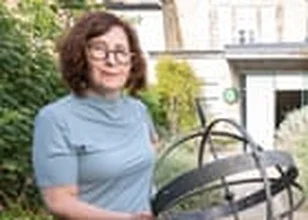
Irish artist Grace Weir created the exhibition. She expressed deep interest in the science conducted at the house. This included the discovery of the planet Uranus. Weir was fascinated that such breakthroughs happened in a cosy home environment.
“It is a home,” Weir explained. “Science does not take place in a vacuum.” She imagined their conversations about discoveries across the dining table. One of her artworks, ‘On the Construction of Heavens’, draws inspiration from William Herschel’s 1785 drawing of the Milky Way.
Weir has embroidered a copy of this drawing onto an antique linen tablecloth. This now graces the family dining table. “William and Caroline must have spoken about the Milky Way’s shape right here,” Weir noted. “That would have been an unusual topic back then.”
In the basement workshop, William Herschel built his own telescopes. Here, Weir installed an LED digital counter. It records the changing distance of Uranus from Earth.
A key aim of the show is to give Caroline Herschel her due credit. She played a crucial role in their scientific advances. William Herschel, a self-taught amateur, arrived in Bath from Germany in 1777. His sister followed, initially serving as a housekeeper.
She quickly became his invaluable assistant. Caroline meticulously recorded findings, aided calculations, and maintained telescopes. Moreover, she made significant discoveries of her own, identifying eight comets. Consequently, she became the first woman in England to earn a salary as an astronomer.
Weir’s striking piece, ‘An Imperfect Account’, pays tribute to Caroline’s comet-spotting skills. It features a meteorite fragment and a piece of obsidian. These are shaped like one of Caroline’s worry beads.
“William had to persuade her mother to let her come to Bath,” Weir revealed. “He recognised her intelligence.” Once in Bath, they collaborated incredibly effectively. “They drove each other along; they understood each other,” Weir added.
Weir’s artworks are scattered throughout the house. Visitors must actively search for them. Weir believes people are losing the art of close observation. “The Herschels were masters of long looking, something we are losing by scrolling,” she stated.
Amy Frost, a senior curator at Bath Preservation Trust, spoke about the exhibition’s significance. She noted it marks the first time contemporary site-specific artworks have been integrated into the museum. “It’s really exciting for us,” she said. “It feels like a thread being created through time.”
The exhibition, titled ‘The As-Yet Unseen’, runs from September 5 until January 3, 2027. This name is a quote from William Herschel, predicting Neptune’s discovery. Furthermore, a second exhibition, exploring the photography of William’s son, John Herschel, also runs until January.